
Dust emission monitoring
PicoFlow Flow Measurement at Low Solid/Air Ratios
A sensor for measuring powder flows in transport lines with very low material concentrations. It fills the gap where dust measuring instruments cannot cope and flow rate instruments are overspecified.
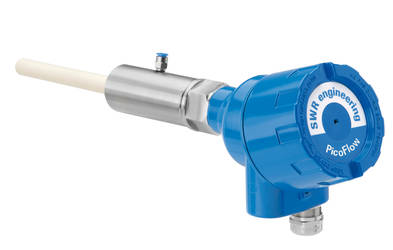
- For pneumatic applications with material flow rates up to 100 kg/h, depending on the application
- Works in free fall at a drop speed of at least 2 m/s (about 25 cm of drop height)
- For cases where dust measuring instruments cannot cope and flow rate instruments are overspecified
- Absolute measurements in g/h or kg/h after calibration
- Ceramic-coated antenna that prevents sensor wear
- Optional air purging system for materials that tend to bake on
Use
Where PicoFlow fits
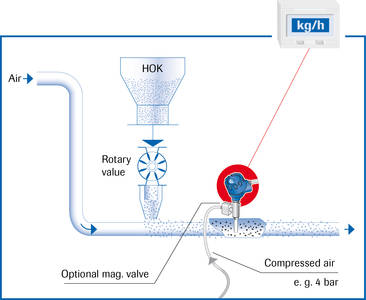
PicoFlow was developed for measuring powder flows in transport lines with very low material concentrations. It is particularly suited to pneumatic applications, and it works reliably in free fall at drop speeds of at least 2 m/s (6.6 ft/s).
After calibration it delivers absolute measurements in g/h or kg/h.
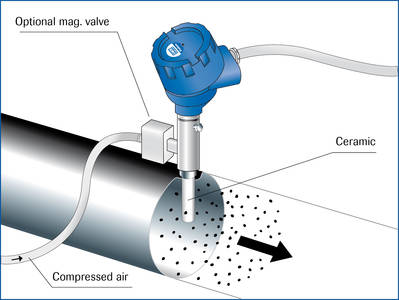
For materials that tend to bake onto surfaces, a special air purging system is available as an option.
Function
How the electrodynamic measurement works
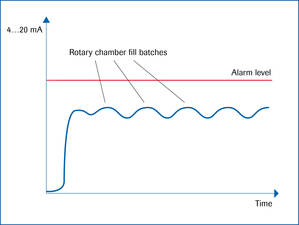
PicoFlow is based on the electrodynamic measuring effect. A ceramic coating on the very short antenna prevents sensor wear, and specially developed hardware and software linearise the measurements.
The transmitter communicates over RS 485 using Modbus.
Mounting and installation
Fitting the sensor in the duct
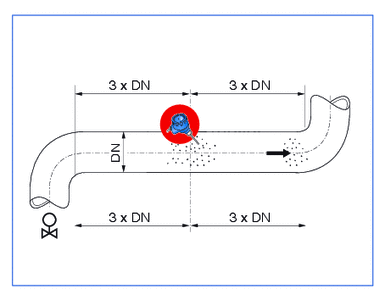
PicoFlow suits metallic ducts and pipelines. Install it as far as possible from bends and fittings such as valves and slides.
- Keep the sensor rod at least 3 × the duct diameter from any fitting, in every flow direction.
- Non-metallic ducts need a metal sleeve, metal foil or tight-mesh metal grille over a length of at least 5 × the duct diameter.
- Drill a hole in the duct wall, weld the supplied socket perpendicular to the pipe, then screw the sensor rod into the socket.
Technical data
PicoFlow specifications
Imperial values are converted from the manufacturer's metric data. Confirm critical values against the product information PDF.
| Measurement range | 100 g/h to 100 kg/h (0.22 to 220 lb/h), depending on the application |
|---|---|
| Process temperature | Standard: 150 °C (302 °F)Optional: max. 500 °C (932 °F) |
| Pressure | Max. 2 bar (29 psi)Optional: up to 25 bar (363 psi) |
| Flow velocity | Min. 2 m/s (6.6 ft/s) |
| Humidity | 60% RH or less (non-condensing) |
| Measurement principle | Electrodynamic |
| Ambient temperature | −20 to +60 °C (−4 to +140 °F) |
| Sensor rod | Stainless steel with Al₂O₃ ceramic, 99.7%; length depends on the application |
| Housing material | Aluminium |
| Protection type | IP 66; ATEX category 1/2 GD |
| Electrical connection | Connection chamber DIN M 20 |
| Switch output, measurement alarm | Changeover relay, max. 250 V AC, 1 A; not on Ex devices of category 1 and 2 |
| Weight | Approx. 1.5 kg (3.3 lb) |
| Power supply | 110/230 V, 50 Hz (optional 24 V DC) |
|---|---|
| Power consumption | 20 W / 24 VA |
| Protection type | IP 65 to EN 60529 |
| Ambient temperature | −10 to +45 °C (+14 to +113 °F) |
| Dimensions | 258 × 237 × 174 mm W × H × D (10.2 × 9.3 × 6.9 in) |
| Weight | Approx. 2.5 kg (5.5 lb) |
| Interface | RS 485 / RS 232 C (Modbus) |
| Cable screw connectors | 3 × M16 (4.5–10 mm Ø) |
| Connection terminals | 0.2–2.5 mm² (AWG 24–14) |
| Current output | 4–20 mA (0–20 mA), load < 500 Ω |
| Switch output, measurement alarm | Changeover relay, max. 250 V AC, 1 A |
| Pulse output | Open collector, max. 30 V, 20 mA |
| Data backup | Flash memory |
| Power supply | 24 V DC ±10% |
|---|---|
| Power consumption | 20 W / 24 VA |
| Protection type | IP 40 to EN 60529 |
| Ambient operating temperature | −10 to +45 °C (+14 to +113 °F) |
| Dimensions | 23 × 90 × 118 mm W × H × D (0.9 × 3.5 × 4.6 in) |
| Weight | Approx. 172 g (6.1 oz) |
| Terminal conductor cross-section | 0.2–2.5 mm² (AWG 24–14) |
| Current output | 4–20 mA (0–20 mA), load < 500 Ω |
| Switch output, measurement alarm | Changeover relay, max. 250 V AC, 1 A |
| Pulse output | Open collector, max. 30 V, 20 mA |
| Data backup | Flash memory |
Common questions
PicoFlow FAQ
What is PicoFlow used for?
Measuring powder flows in transport lines with very low material concentrations, where dust measuring instruments cannot cope and flow rate instruments are overspecified.
What flow range does PicoFlow cover?
100 g/h to 100 kg/h, depending on the application.
Does PicoFlow work in free fall?
Yes, at a drop speed of at least 2 m/s, which is about 25 cm of drop height.
Does PicoFlow give absolute values?
Yes. After calibration it delivers absolute measurements in g/h or kg/h.
How does PicoFlow resist wear?
A ceramic coating on the very short antenna prevents sensor wear.
What about materials that bake on?
A special air purging system is available as an option for materials that tend to bake onto surfaces.
Talk with GTS
Is PicoFlow right for your material?
Tell us what powder you're conveying, the flow rate and the line size. We'll confirm whether PicoFlow fits or recommend a better option.