
Moisture measurement
MSP Moisture Sensing Probe
An online moisture probe for continuous measurement in dry bulk solids. It has no moving parts, a stainless steel housing with a ceramic face for abrasion resistance, and versions for conveyors, silos and mixers.

- Continuous moisture measurement in dry bulk solids
- Contact measurement, passive, with no moving parts (non-contact IR models are optional)
- Moisture range of 0 to 85%
- Output signal: 0/4–20 mA or 0–10 V
- Compact design with a stainless steel housing and a ceramic face for high abrasion resistance
- Accuracy of 0.1 to 0.5%, depending on installation, calibration and process conditions
- General purpose or Ex certified
- Reliable, long-term stable and maintenance-free
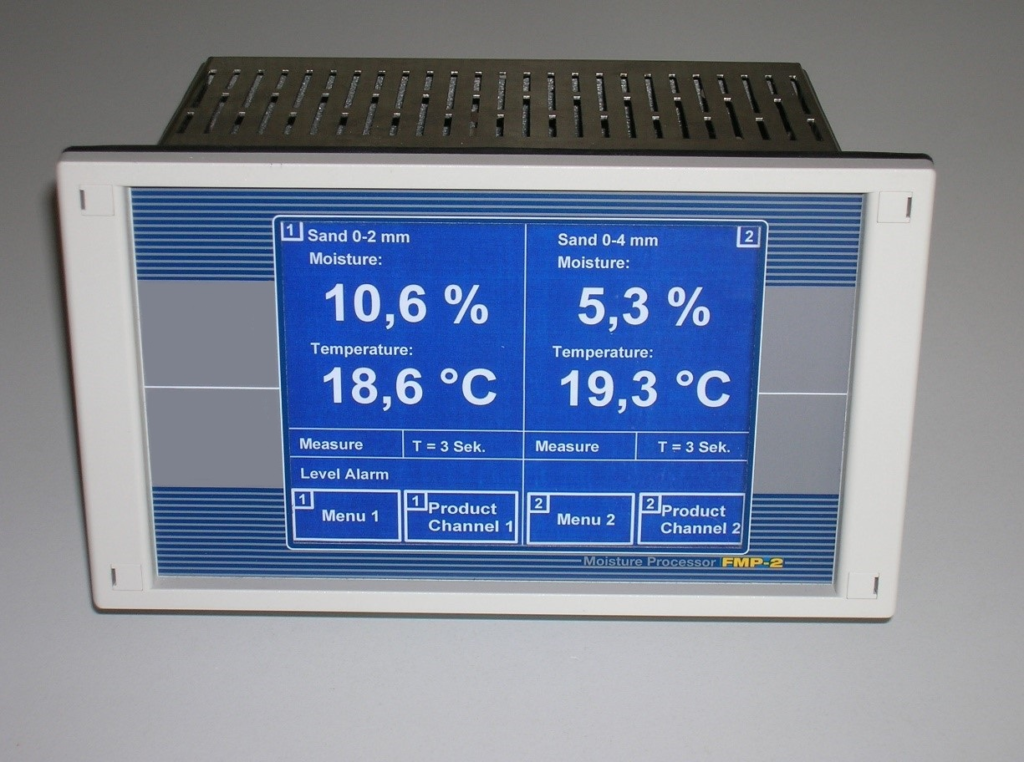
- FMP-2 touch-screen transmitter for higher accuracy with multiple calibration points
- High-temperature version up to 190 °C (374 °F)
Use
Where the MSP fits
The MSP measures the water content of bulk solids in real time. Typical applications:
- Sand, gravel and similar materials in concrete production
- Reprocessing foundry sand to a target moisture content
- Quartz sand, for example for glass manufacturers
- Quality control in food processing
- Corn production and animal feed
- Wood chips, sawdust, wood shavings and wood pellets
- Ceramic powders and pastes, and metal oxides
- Sludge from sewage plants
Function
The HPR method
The probes use the HPR method: high-frequency dielectric polarisation and field refraction. The measuring signal is linearised digitally inside the probe.
Calibration is done through an integrated adjustment unit. The FMP-2 touch-screen transmitter allows multiple calibration points for higher accuracy.
Versions
Five probes for different installations
- MSP-Standard: the standard online probe, for example on a conveyor.
- MSP-DISC: a disc sensor with a large diameter, for a wide detection area. Used on gravel and on sand silos.
- MSP-INSERT: an insertion probe for streaming material, such as a silo outlet. It mounts from outside the silo.
- MSP-MIXER: a robust mixer sensor with changeable wear protection, for bottom or wall mounting.
- MSP-HT: a high-temperature version rated to 190 °C (374 °F).
Replaceable wear protection comes in special ceramic, which is extremely abrasion resistant, or wear-resistant rubber, which is abrasion resistant and impact proof.
Technical data
MSP specifications
Transcribed from the product brochure, which lists only these values. Ask GTS for dimensions, temperatures and materials for a specific model.
| Moisture range | 0 to 85% |
|---|---|
| Accuracy | 0.1 to 0.5%, depending on installation and correct calibration |
| Output signal | 0/4–20 mA or 0–10 V |
| Power supply | 9 to 30 V DC |
| Degree of protection | IP68 |
| Calibration | Through the integrated adjustment unit |
| Linearization | Internal digital linearization of the measuring signal |
| Maximum temperature (MSP-HT) | 190 °C (374 °F) |
| Housing | Stainless steel with a ceramic face |
Application examples
MSP in real processes



Common questions
MSP FAQ
What does the MSP measure?
Moisture in dry bulk solids, continuously, over a range of 0 to 85%.
How accurate is the MSP?
0.1 to 0.5%, depending on installation, calibration and process conditions.
What versions of the MSP are there?
MSP-Standard, MSP-DISC with a large disc sensor, MSP-INSERT for streaming material such as a silo outlet, MSP-MIXER for mixers, and MSP-HT for temperatures up to 190 °C.
What output does the MSP provide?
A 0/4–20 mA or 0–10 V signal.
How does the MSP resist abrasion?
It has a ceramic face, and the newest sensors take replaceable wear protection in special ceramic or wear-resistant rubber.
What materials is the MSP used on?
Sand and gravel, foundry sand, quartz sand, food products, corn and animal feed, wood chips and pellets, ceramic powders, metal oxides and sewage sludge.
Talk with GTS
Is the MSP right for your material?
Tell us what material you're measuring, where it moves and the moisture range you expect. We'll recommend the right MSP version.