
Solids velocity measurement
Dvel Velocity Measurement for Bulk Solids
An instrument for accurate velocity measurement of dust, powder or granules moving through pneumatic conveying systems or gravity pipelines. The measurement is absolute, so it needs no calibration.
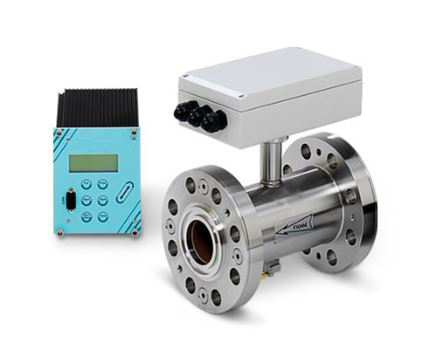
- Extremely accurate velocity measurement for bulk solids
- Measures dust, powder or granules in pneumatic conveying and gravity pipes
- Non-contact measurement
- Calibration-free
- Maintenance-free
- Adjusts automatically to different products and process conditions
- Damping adjustable from 1 to 30 s, with a fast response to rapid changes
Use
Where Dvel fits
Dvel measures how fast bulk material such as dust, powder or granules moves through pneumatic conveying systems or gravity pipelines.
Within a control concept, the velocity reading can help reduce product degradation and abrasion and cut the amount of conveying gas needed. Paired with a concentration measurement, it can be used to calculate mass flow rate.
Function
How the velocity is measured
Dvel detects moving particles only. Stationary particles are not detected.
Two sensors inside the instrument record signals a set distance apart. A cross-correlation of the two signals gives the transit time between the sensors, and the velocity follows from that.
Because this is an absolute measurement, no calibration is required. The device adjusts automatically to different products and process conditions.
Dvel cannot be used if the product forms an electrically conductive layer on the pipe walls through abrasion or caking.
Mounting and installation
Flange installation and sizes
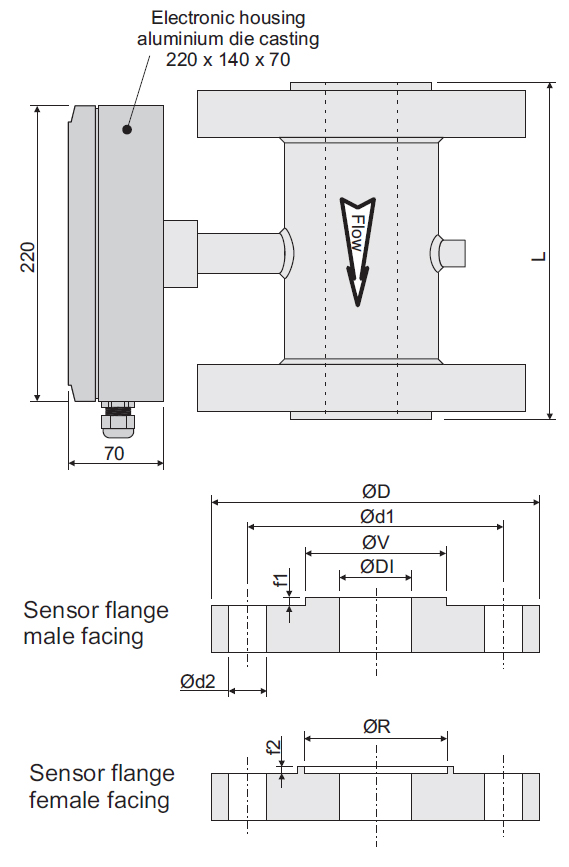
Dvel installs in the line with a DIN flange, in nominal diameters from DN 10 to DN 400 and pressure ratings from PN 10 to PN 64. Flange facings are available as male and female, female on both sides, or male on both sides (standard).
Settings are made over the CAN bus, from the system controller or a notebook.

Technical data
Dvel specifications
Transcribed from the product brochure, with converted units added. Confirm critical values against the brochure PDF.
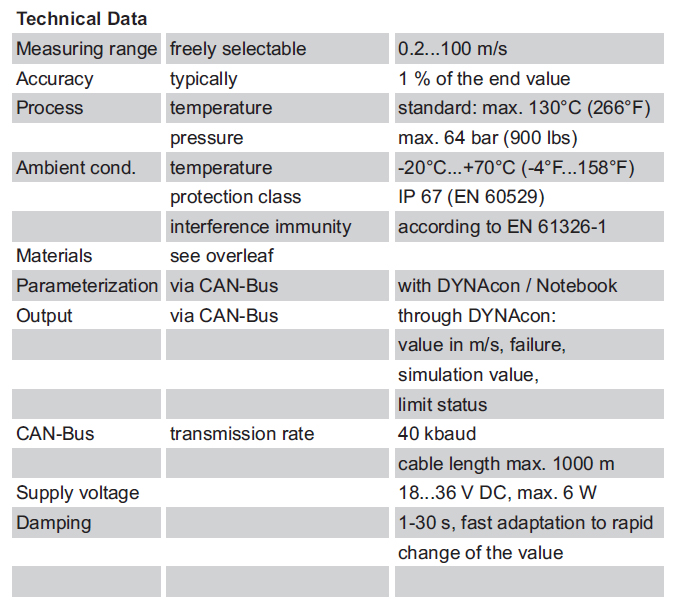
| Measuring range | Freely selectable, 0.2 to 100 m/s (0.66 to 328 ft/s) |
|---|---|
| Accuracy | Typically 1% of end value |
| Output signals (over the CAN bus) | Velocity in m/s, failure, simulation value, limit status |
| Process temperature | Max. 130 °C (266 °F), standard |
|---|---|
| Process pressure | Max. 64 bar (928 psi) |
| Ambient temperature | −20 to +70 °C (−4 to +158 °F) |
| Protection class | IP 67 (EN 60529) |
| Interference immunity | According to EN 61326-1 |
| Supply voltage | 18 to 36 V DC |
|---|---|
| Power consumption | Max. 6 W |
| Damping | 1 to 30 s |
| CAN bus transmission rate | 40 kbaud |
| Maximum cable length | 1000 m (3,280 ft) |
| Process coupling | DIN flange |
|---|---|
| Nominal diameter | DN 10 to DN 400 |
| Nominal pressure | PN 10, 16, 25, 40 or 64 |
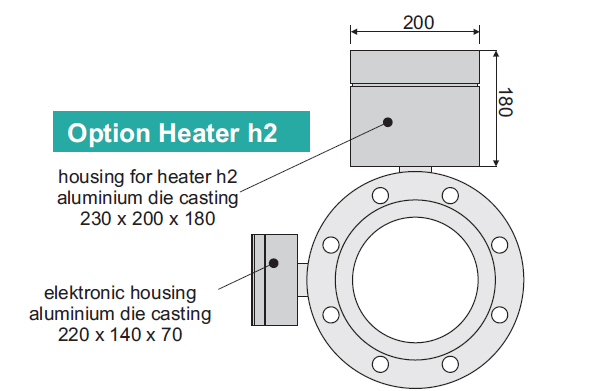
| Electronics housing | Aluminium die casting, 220 × 140 × 70 mm (8.7 × 5.5 × 2.8 in) |
| Sensor pipe materials | PTFE, PEEK, PVC, PA, PE, UHMW PE, POM, PVDF |
| Seal materials | NBR, FPM/FKM, silicone |
| ATEX zone | 2 and/or 22 |
|---|---|
| Gas marking | II 3G Ex nA IIB T4 Gc |
| Dust marking | II 3D Ex tc IIIB T100 °C Dc IP65 |
Common questions
Dvel FAQ
What does Dvel measure?
How fast bulk material such as dust, powder or granules moves through pneumatic conveying systems or gravity pipelines.
How does Dvel work?
Two sensors inside the instrument record signals a set distance apart. A correlation of the two signals gives the transit time between them, and the velocity follows from that.
Does Dvel need calibration?
No. It is an absolute measurement, and the device adjusts automatically to different products and process conditions.
What velocity range does Dvel cover?
A freely selectable range from 0.2 to 100 m/s (0.66 to 328 ft/s), with a typical accuracy of 1% of the end value.
Can Dvel be used to measure mass flow?
Paired with a concentration measurement, the velocity reading can be used to calculate mass flow rate.
When can Dvel not be used?
When the product forms an electrically conductive layer on the pipe walls through abrasion or caking.
Talk with GTS
Is Dvel right for your material?
Tell us what you're conveying, the line size and the pressure. We'll confirm whether Dvel fits or recommend a better option.