
Solids velocity measurement
SpeedFlow Speed Measurement for Solids
A sensor for continuous speed measurement of solids such as powder, granules and dust in metal pipes. It measures directly in the conveying stream, in free fall or pneumatic lines, and the result does not depend on the material.
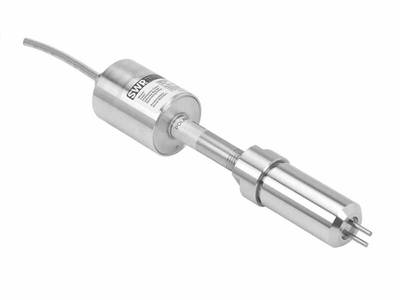
- Usable in free fall and in pneumatic conveying
- Continuous speed measurement of solids (powder, granules, dust) in metal pipes
- Measurement directly in the conveying stream
- Measurement is completely independent of the material
- Simple retrofitting using a welding socket
Use
Where SpeedFlow fits
SpeedFlow is designed for continuous speed measurement of solids such as granules, powder and dust in metal pipes. It can be used in free-fall lines or pneumatic conveyors, and the measurement is independent of the material.
The application range starts at a material speed of 0.75 m/s (2.5 ft/s).
Function
How the speed is measured
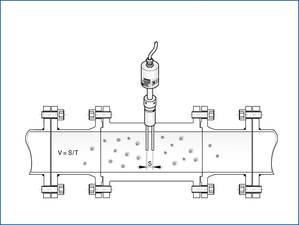
SpeedFlow works on the triboelectric effect. Particles striking the two sensor rods transfer charge to them, which induces a voltage.
A correlator measures the transit time between the two rods. The rods are a fixed 8 mm (0.31 in) apart, and the speed is calculated from that distance and the transit time.
Commissioning is done with the sensor installed, and the result is output as a 4–20 mA signal.
Mounting and installation
Retrofit with a welding socket
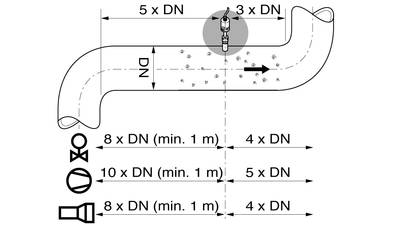
The installation point is chosen based on the inlet and outlet paths of the conveyed material.
- Weld the socket at the specified location.
- Drill a 20 mm (0.79 in) bore through the socket and the pipe wall.
- Adjust the sensor to the wall thickness and insert it.
- Secure the sensor with the coupling nut.
The sensor can be up to 300 m (984 ft) from the analysis unit.
Technical data
SpeedFlow specifications
Imperial values are converted from the manufacturer's metric data. Confirm critical values against the product information PDF.
| Socket | Steel St 52 or stainless steel 1.4571 |
|---|---|
| Rod | Tungsten carbide (abrasion-resistant) |
| Housing | Stainless steel 1.4571 |
| Protection category | IP 65 to EN 60529 |
| Rod length | 15 mm (0.59 in) |
| Velocity range | 0.75 to 35 m/s (2.5 to 115 ft/s) |
| Temperature inside the pipe | −20 to 80 °C (−4 to 176 °F); higher temperatures on request |
| Temperature outside the pipe | 0 to +60 °C (32 to 140 °F) |
| Weight | Approx. 1.5 kg (3.3 lb) |
| Dimensions | Ø 60, Ø 20, length 320 mm including the rod (Ø 2.4 in, Ø 0.8 in, 12.6 in) |
| Measurement accuracy | ±1% in the calibrated measuring range |
| Power supply | 24 V DC ±10% |
|---|---|
| Power consumption | 20 W / 24 VA |
| Protection type | IP 40 to EN 60529 |
| Ambient operating temperature | −10 to +45 °C (+14 to +113 °F) |
| Dimensions | 23 × 90 × 118 mm W × H × D (0.9 × 3.5 × 4.6 in) |
| Weight | Approx. 172 g (6.1 oz) |
| DIN rail fastening | DIN 60715 TH35 |
| Connection terminal cross-section | 0.2–2.5 mm² (AWG 24–14) |
| Current output | 4–20 mA (0–20 mA), load < 500 Ω |
| Switch output, measurement alarm | Relay with changeover contact, max. 250 V AC, 1 A |
| Data backup | Flash memory |
| Dimensions | 98 × 64 × 35 mm W × H × D (3.9 × 2.5 × 1.4 in) |
|---|
Common questions
SpeedFlow FAQ
What does SpeedFlow measure?
The speed of solids such as granules, powder and dust in metal pipes, continuously, in free-fall lines or pneumatic conveyors.
How does SpeedFlow work?
Particles striking two sensor rods transfer charge to them. A correlator measures the transit time between the rods, which are a fixed 8 mm apart, and the speed is calculated from that.
Does the material affect the SpeedFlow measurement?
No. The measurement is completely independent of the material.
What speed range does SpeedFlow cover?
0.75 to 35 m/s (2.5 to 115 ft/s), with an accuracy of ±1% in the calibrated measuring range.
How is SpeedFlow installed?
A socket is welded to the pipe, a 20 mm bore is drilled through the socket and pipe wall, and the sensor is inserted and secured with a coupling nut.
What output does SpeedFlow provide?
A 4–20 mA signal, plus a relay for a measurement alarm.
Talk with GTS
Is SpeedFlow right for your material?
Tell us what you're conveying, the pipe size and how it moves. We'll confirm whether SpeedFlow fits or recommend a better option.