
Flow / no flow detection
FLOWguard P Triboelectric Flow Monitor
A short-range triboelectric flow monitor for solids in free fall, sliding or pneumatic systems. It works as a flow / no flow switch or as a trend indicator with a 4–20 mA output.
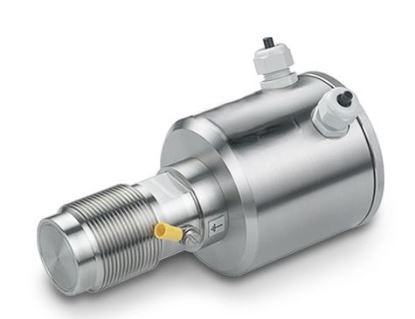
- Triboelectric technology
- Available as a flow / no flow switch or a trend indicator
- Integral monitor with 4–20 mA (trend) or relay (switch) output
- Detects moving material only, with no influence from deposits or rotating objects more than 6 inches away
- Long-term stable, reliable and maintenance-free
- Stainless steel 1.4305 (AISI 303) housing
- General purpose or Ex versions
Use
Where FLOWguard P fits
FLOWguard P detects solids moving through open or closed conveying systems, in either direction, at a minimum speed of 0.1 m/s (0.33 ft/s). It flags problems such as clogs and wasted material early.
The detection area extends about 4 to 6 inches from the sensor face.
FLOWguard P cannot be used with products that form an electrically conductive layer on the sensor through friction or deposition.
Function
How the electrostatic measurement works
FLOWguard P uses the electrostatic principle, based on electrostatic induction. Charged particles passing the sensor induce a signal against the grounded transport channel. The current noise in that signal rises with particle concentration and transport speed, and the electronics scale it to a mass throughput or concentration reading. Adjustment is manual, through internal controls.
Because only moving charges produce a signal, caking and deposits have no effect.
Mounting and installation
Installation in five steps
- Weld on the welding socket.
- Drill through the socket centrically, with a bore of at least 43 mm (1.69 in).
- Apply PTFE sealant to the thread.
- Tighten the device with an SW 36 spanner.
- Establish grounding.
Technical data
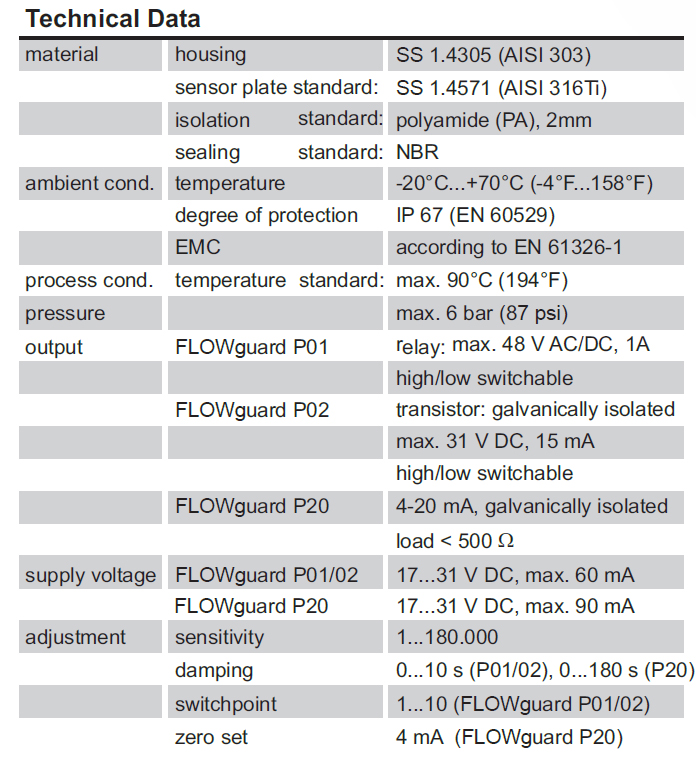
FLOWguard P specifications
Transcribed from the product brochure, with converted units added. Confirm critical values against the brochure PDF.
| Supply voltage | P01/P02: 17 to 31 V DC, max. 60 mAP20: 17 to 31 V DC, max. 90 mA |
|---|---|
| Relay output (P01) | Max. 48 V AC/DC, 1 A; high / low switchable |
| Transistor output (P02) | Galvanically isolated, max. 31 V DC, 15 mA |
| Analog output (P20) | 4–20 mA, galvanically isolated, load < 500 Ω |
| Delay | P01/P02: 0 to 10 sP20: 0 to 180 s |
| Switch point (P01/P02) | 1 to 10 |
| Zero set (P20) | 4 mA |
| Sensitivity adjustment | 1 to 180,000 |
| Mass flow range | From lbs/hr to t/hr |
|---|---|
| Process temperature | Max. 90 °C (194 °F) |
| Pressure | Max. 6 bar (87 psi) |
| Ambient temperature | −20 to +70 °C (−4 to +158 °F) |
| Degree of protection | IP 67 (EN 60529) |
| EMC | EN 61326-1 |
| Ex2 option | ATEX Zone 2 and 22: II 3G EEx nA II T4; II 3D IP67 T100°C |
| Sensor plate | Polyamide (PA), 2 mm isolation (standard)Options: stainless steel 1.4305 (AISI 303), stainless steel 1.4571 (AISI 316Ti), PTFE, PEEK |
|---|---|
| Sealing | NBR (standard); FPM or silicone optional |
| Thread bush | 1.4301 (AISI 304) or 1.4571 (AISI 316Ti) |
| Thread | G 1½ in |
| Cable glands | M16 × 1.5 |
Common questions
FLOWguard P FAQ
How far does FLOWguard P detect?
The detection area extends about 4 to 6 inches from the sensor face. Rotating objects more than 6 inches away are ignored.
How does FLOWguard P work?
It uses the electrostatic principle. Charged particles passing the sensor induce a signal against the grounded transport channel, and the noise in that signal rises with particle concentration and transport speed.
Is FLOWguard P a switch or a trend monitor?
Both versions exist. The relay version is a flow / no flow switch and the 4–20 mA version is a trend indicator.
What is the minimum material speed for FLOWguard P?
0.1 m/s (0.33 ft/s), in either direction.
Do deposits affect FLOWguard P?
No. Deposits and caking produce no signal, because only moving charges are detected.
What can FLOWguard P not be used with?
Products that form an electrically conductive layer on the sensor through friction or deposition.
Talk with GTS
Is FLOWguard P right for your material?
Tell us what material is moving, how it's conveyed and what you need to detect. We'll confirm whether FLOWguard P fits or recommend a better option.