
Solids flow meters
MaxxFlow HTC Mass Flow Meter for High Throughput
A fall-through meter for high mass flow rates of dry bulk solids after mechanical conveyors such as screw conveyors, air slides, rotary valves and bucket elevators, with a completely open cross-section.
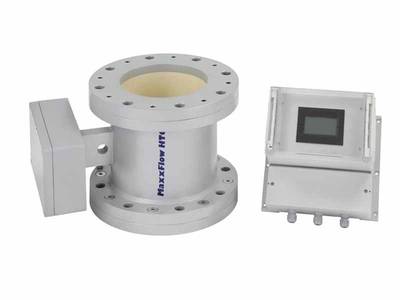
- Measures most non-metallic solids
- Installs on round pipes or ducts
- No real upper limit of mass flow
- Maximum pressure 10 bar (145 psi)
- Dust tight
- No flow restriction, with a wear-resistant ceramic liner
- Measurement is independent of flow characteristics
- Maximum temperature 120 °C (248 °F)
- Can be installed at an angle
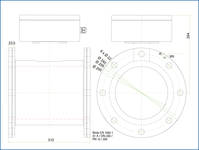
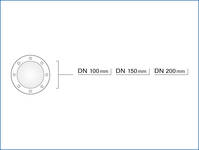
- Small footprint: 220 mm (DN 100), 290 mm (DN 150), 310 mm (DN 200)
- No moving parts, so no maintenance
Use
Where MaxxFlow HTC fits
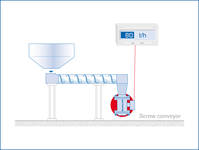
The MaxxFlow HTC was developed for flow measurement of dry bulk solids at high-volume throughput. With its completely open cross-section and low installation height, it suits situations where only complicated or expensive mechanical solutions, such as impact plates or measuring chutes, could be used before.
It can be installed in vertical or inclined lines, but always after mechanical conveying elements such as rotary feeders, screw conveyors, air slides or chain conveyors.

Function
How the measurement works
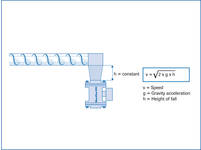
After the conveyor, the material falls or slides through an inlet path and passes through the sensor. During throughput the MaxxFlow HTC records the material concentration and speed. Because the material falls from a constant height after leaving the conveying element, its speed is constant at the sensor position. The speed measurement therefore doesn't always need to be active and can be calculated as a constant from the fall height. The mass flow is determined as:
Q (kg/s) = K (kg/m³) × v (m/s) × A (m²)
A high-frequency electromagnetic alternating field is coupled in to generate a homogeneous measuring field in the measuring tube. The measuring tube, the inner tube of the sensor, is made of wear-resistant Al₂O₃ ceramic. Dry bulk solids inside the field reduce its amplitude, giving a measuring signal proportional to the concentration of solids in the sensor (kg/m³).
If the material speed varies, for example because the initial speed changes, it can also be measured. This is done by a runtime measurement using two additional electrodes behind the inner ceramic tube.

Mounting and installation
What a measuring station includes
A complete measuring station consists of:
- A measuring feeder for installation in the conveyor line
- A transmitter
The measuring feeder is available in sizes DN 100, DN 150 and DN 200. On request, the inlet path (between the conveying element and the sensor) and a gate valve for calibration can also be configured and supplied.
The transmitter connects to the sensor with a 4-wire shielded cable. The maximum distance between measuring feeder and transmitter is 300 m (984 ft).



Technical data
MaxxFlow HTC specifications
Imperial values are converted from the manufacturer's metric data. Confirm critical values against the product information PDF.
| Housing | Steel St 52, powder-coated (optional stainless steel 1.4571)NW 100/150/200 mm, flange according to EN 1092-1 / PN 10 |
|---|---|
| Inner pipe | Ceramic Al₂O₃ |
| Protection category | IP 65 |
| Operating temperature | Sensor electronics: 0 to +60 °C (+32 to +140 °F)Sensor pipe: −20 to +120 °C (−4 to +248 °F) |
| Max. working pressure | 1 bar (14.5 psi), optional 10 bar (145 psi) |
| Working frequency | 88 kHz |
| Transmitting power | Max. 2 mW |
| Weight | Depending on model |
| Accuracy | ±3% (based on end of measuring range and calibrated material) |
| Power supply | 110/240 V AC, 50 Hz, optional 24 V DC |
|---|---|
| Power consumption | 20 W / 24 VA |
| Operating temperature | −10 to +45 °C (+14 to +113 °F) |
| Dimensions | 258 × 237 × 174 mm W × H × D (10.2 × 9.3 × 6.9 in) |
| Weight | Approx. 2.5 kg (5.5 lb) |
| RS 485 interface | Modbus |
|---|---|
| Terminal clamp wire size | 0.2–2.5 mm² (AWG 24–14) |
| Current output signal | 2 × 4–20 mA (0–20 mA), load < 500 Ω |
| Serial output | RS 485, Modbus protocol |
| Data backup | Flash memory |
| Cable glands | 3 × M16 (4.5–10 mm Ø) |
Application examples
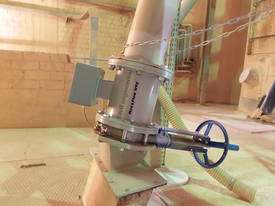
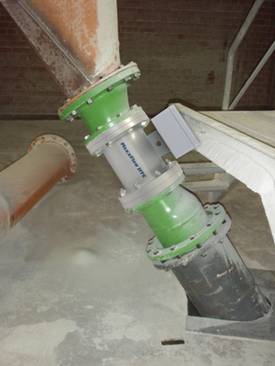
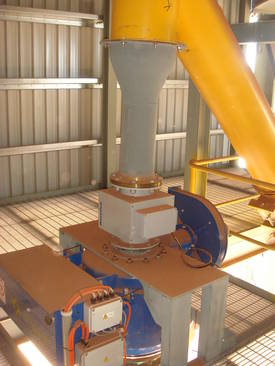
MaxxFlow HTC throughput measurement in real processes




Common questions
MaxxFlow HTC FAQ
Where is the MaxxFlow HTC installed?
In vertical or inclined lines, always after mechanical conveying elements such as rotary feeders, screw conveyors, air slides or chain conveyors.
What materials can the MaxxFlow HTC measure?
Most non-metallic dry bulk solids.
How does the MaxxFlow HTC determine mass flow?
It measures the concentration of solids in the measuring tube from the damping of a high-frequency electromagnetic alternating field, and multiplies it by the material speed and the tube cross-section: Q = K × v × A.
Does the MaxxFlow HTC restrict the material flow?
No. The cross-section is completely open, with a wear-resistant ceramic liner and no moving parts.
What sizes does the MaxxFlow HTC come in?
DN 100, DN 150 and DN 200, with footprints of 220 mm, 290 mm and 310 mm.
How accurate is the MaxxFlow HTC?
±3%, based on the end of the measuring range and calibrated material.
Talk with GTS
Is MaxxFlow HTC right for your material?
Tell us what you're conveying, the pipe size and how it moves. We'll confirm whether MaxxFlow HTC fits or recommend a better measurement principle.