
Flow / no flow detection
FLOWguard S Flow Monitor for Powders in Hoses
A flow monitor for powders in flexible hoses from 4 to 38 mm in diameter. It gives a flow trend through a 4–20 mA output or a relay alarm for flow / no flow, and detects very slow powder movement.
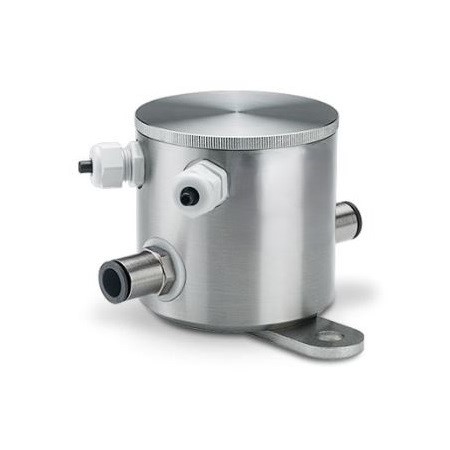
- Three versions for monitoring powders in flexible hoses (T, E and W)
- Easy installation and start-up
- Integral solids flow trending with a 4–20 mA output, or a relay for flow / no flow alarm
- Installs on any tube or hose from 4 to 38 mm diameter, conductive or non-conductive
- Long-term stable, reliable, robust and repeatable outputs
- Stainless steel 1.4305 (AISI 303) housing
- General purpose or Ex versions
- Measures very slow powder movement
Use
Where FLOWguard S fits
FLOWguard S monitors solids flow in hose lines. A switching output signals whether a set limit is exceeded or not reached, and the 4–20 mA version outputs a trend.
It detects blockages, empty storage containers, rat holes and bridging during pneumatic transport of granules, powders, blasting agents, abrasives, dust and other bulk materials.
Function
How the hose sensor detects flow
FLOWguard S senses the electrical charges that particles pick up through friction on the hose wall. Only moving particles produce a signal, so stationary solids are not detected.
The relay version alarms when a threshold is crossed, for example when a feed bin runs empty or a plug forms. The analog version trends flow with a 4–20 mA signal.
FLOWguard S cannot be used if the bulk solids form an electrically conductive layer on the inner hose wall.
Mounting and installation
Three hose fitting versions
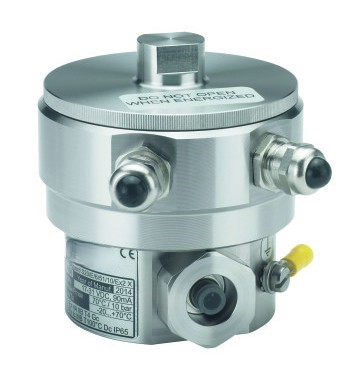
- Version T (pass-through): the hose is passed through the instrument and fastened with a screw connection. For non-conductive hoses.
- Version E (plug-in): the hose is cut and plugged into fittings from both sides. For conductive hoses or larger diameters.
- Version W (plug-on): the hose is fixed on nozzles from both sides. For conductive hoses or larger diameters.
The device is rated IP 67 to EN 60529.
Technical data
FLOWguard S specifications
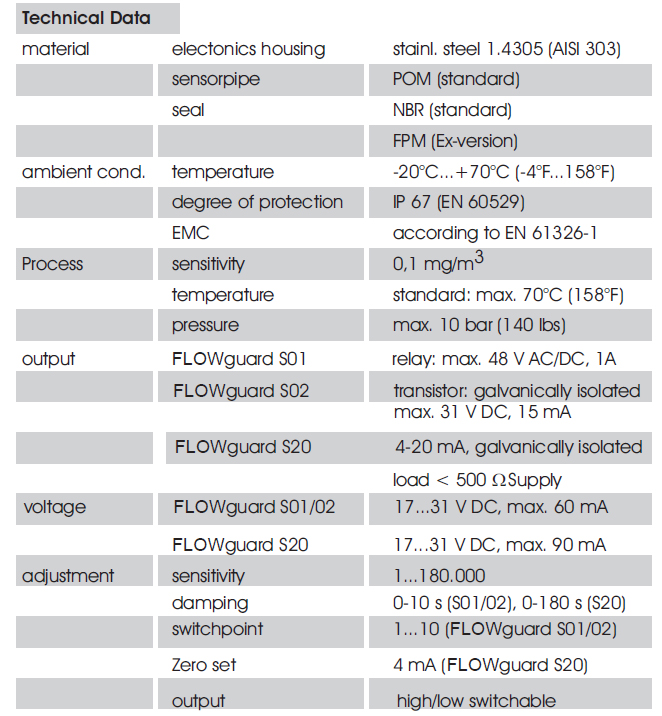
Transcribed from the product brochure, with converted units added. Confirm critical values against the brochure PDF.
| Supply voltage | S01/S02: 17 to 31 V DC, max. 60 mAS20: 17 to 31 V DC, max. 90 mA |
|---|---|
| Relay output (S01) | Max. 48 V AC/DC, 1 A |
| Transistor output (S02) | Galvanically isolated, max. 31 V DC, 15 mA |
| Analog output (S20) | 4–20 mA, galvanically isolated, load < 500 Ω |
| Switching | High / low switchable |
| Damping | S01/S02: 0 to 10 sS20: 0 to 180 s |
| Switch point (S01/S02) | 1 to 10 |
| Zero set (S20) | 4 mA |
| Sensitivity adjustment | 1 to 180,000 |
| Ambient temperature | −20 to +70 °C (−4 to +158 °F) |
|---|---|
| Process temperature | −20 to +70 °C (−4 to +158 °F) |
| Process pressure | Version E: max. 10 bar (145 psi)Version T: specified by the hose |
| Process sensitivity | 0.1 mg/m³ |
| Degree of protection | IP 67 (EN 60529) |
| EMC | EN 61326-1 |
| Ex2 option | ATEX Zone 2: II 3G Ex nA IIB T4 GcATEX Zone 22: II 3D Ex tc IIIB T100°C Dc IP65 |
| Version E, hose outer diameter | 4, 6, 8, 10, 12, 14, 16 mm (0.16 to 0.63 in) |
|---|---|
| Version T, hose outer diameter | 4 to 8 mm and 6 to 12 mm (0.16 to 0.47 in) |
| Version W, nozzle inner / outer diameter | 16/19 mm and 34/38 mm (0.63/0.75 in and 1.34/1.5 in) |
| Electronics housing | Stainless steel 1.4305 (AISI 303) |
| Sensor tube | POM (standard); PA for the Ex version |
| Seals | NBR (standard); FPM for the Ex version |
| Weight | Version E: 1.5 kg (3.3 lb)Version T: 1.6 kg (3.5 lb) |
| Hose 4 mm OD / 2.7 mm ID | 113 mm (4.45 in) |
|---|---|
| Hose 6 mm OD / 4 mm ID | 116 mm (4.57 in) |
| Hose 8 mm OD / 6 mm ID | 132 mm (5.20 in) |
| Hose 10 mm OD / 8 mm ID | 129 mm (5.08 in) |
| Hose 12 mm OD / 10 mm ID | 144 mm (5.67 in) |
| Hose 14 mm OD / 12 mm ID | 146 mm (5.75 in) |
| Hose 16 mm OD / 13 mm ID | 155 mm (6.10 in) |
Common questions
FLOWguard S FAQ
What hose sizes does FLOWguard S fit?
Any tube or hose from 4 to 38 mm in diameter, conductive or non-conductive, depending on the version.
What is the difference between the T, E and W versions?
With version T the hose passes through the instrument, for non-conductive hoses. With version E the hose is cut and plugged into fittings from both sides. With version W the hose is fixed on nozzles from both sides. E and W suit conductive hoses or larger diameters.
What does FLOWguard S detect?
Blockages, empty storage containers, rat holes and bridging during pneumatic transport of granules, powders, blasting agents, abrasives, dust and other bulk materials.
How does FLOWguard S work?
It senses the electrical charges that particles pick up through friction on the hose wall. Only moving particles produce a signal.
What outputs does FLOWguard S have?
A relay for flow / no flow alarm, a transistor output, or a 4–20 mA output for trending flow.
When can FLOWguard S not be used?
When the bulk solids form an electrically conductive layer on the inner hose wall.
Talk with GTS
Is FLOWguard S right for your material?
Tell us what powder you're conveying, the hose size and whether the hose is conductive. We'll confirm which FLOWguard S version fits.