
Point level detection
ProGap Microwave Barrier for Level Detection
A microwave barrier for contactless detection of dry bulk solids in containers, pipes or shafts. It is a compact device with no separate electronics, and it retrofits simply through a threaded connection.
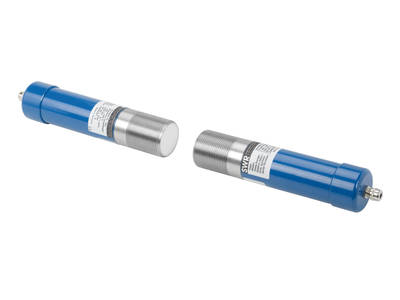
- Simple, uncomplicated retrofitting
- Reliable fill level and limit level detection
- Detection through all non-conductive walls
- With a process adapter, usable up to 220 °C (428 °F) and 20 bar (290 psi)
- With ceramic mounting, usable up to 1,000 °C (1,832 °F)
- Insensitive to material caking
- Usable up to a profile of 18 m (59 ft), with larger profiles on request
- Compact device with no separate electronics
- Signals through relay switching
- Also available in a short housing with separate electronics
Use
Where ProGap fits
ProGap is a universal sensor with a transmitter and a receiver, based on current microwave technology in the K band. It detects the limit level of dry bulk solids of all types, and can also position objects, without contact.
It installs in containers, pipelines, shafts and free-fall sections, with a range of 0 to 4 m or 0 to 18 m depending on the model. Larger ranges are possible.
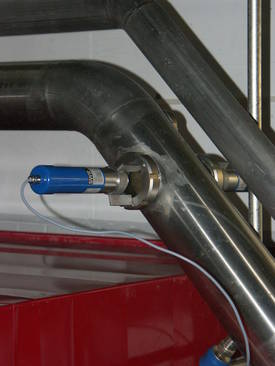
If container walls, housings or pipes are non-metallic, the measurement can be made from the outside. Non-metallic windows separate the measurement from the process completely, which helps with aggressive, abrasive or coarse materials and with extreme pressures or temperatures. A process adapter extends use to high operating temperatures and pressures.
Because it works with microwaves, the sensor is largely insensitive to caking on the sensor window.
Mounting and installation
Mounting transmitter and receiver
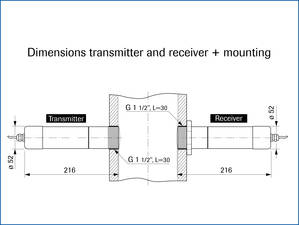
The transmitter and receiver each screw into a G 1½ in threaded connection. The installation height is flexible, as long as both units are at the same height.
Alignment uses a counter-threaded connection, and a signal-intensity display helps with it.
Power connects to both the transmitter and the receiver. The switch output is on the receiver, so no separate analysis unit is needed.
Technical data
ProGap specifications
Imperial values are converted from the manufacturer's metric data. Confirm critical values against the product information PDF.
| Material | Housing: stainless steel 1.4571Sensor isolation: POM |
|---|---|
| Protection system | IP 65; DustEx optional |
| Working temperature | −20 to +80 °C (−4 to +176 °F)−20 to +220 °C (−4 to +428 °F) with process adapterMax. 1,000 °C (1,832 °F) with ceramic flange |
| Ambient temperature | −20 to +60 °C (−4 to +140 °F) |
| Working pressure | Max. 1 bar (14.5 psi)Max. 20 bar (290 psi) with process adapter |
| Detection range | 0 to 4 m (13 ft)0 to 18 m (59 ft)Over 18 m on demand |
| Power supply | 24 V DC (−10/+15%) or 24 V AC (−10/+15%) |
| Power consumption | Approx. 1.8 VA |
| Current consumption | Max. 100 mA |
| Relay output (max.) | 120 V AC/DC, 1.25 A, 150 VA / 50 W |
| Response time | 0.25 to 5 s, continuously adjustable |
| Measuring frequency | K-band 24.125 GHz (±100 MHz) |
| Transmitting power | Max. 5 mW |
| Weight | Transmitter: 1.1 kg (2.4 lb)Receiver: 1.1 kg (2.4 lb) |
Application examples
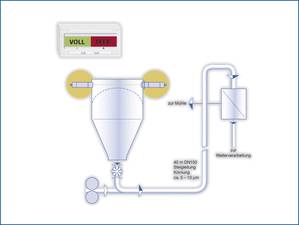
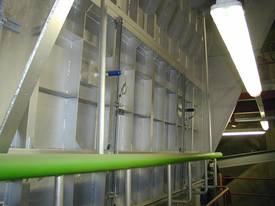
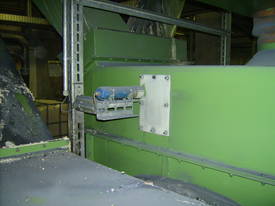
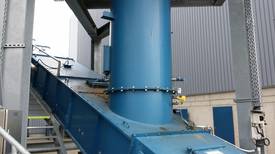
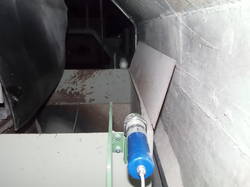
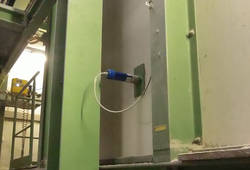
ProGap fill level monitoring in real processes
Common questions
ProGap FAQ
What does ProGap detect?
The fill level and limit level of dry bulk solids of all types, without contact. It can also position objects.
What range does ProGap cover?
0 to 4 m or 0 to 18 m (59 ft) depending on the model. Larger ranges are possible on request.
Does ProGap need separate electronics?
No. It is a compact device. Power connects to both the transmitter and the receiver, and the switch output is on the receiver. A short-housing version with separate electronics is also available.
Can ProGap measure through a wall?
Yes, through all non-conductive walls. Non-metallic windows separate the measurement from the process completely.
Does material caking affect ProGap?
It is largely insensitive to caking on the sensor window, because it works with microwaves.
What conditions can ProGap handle?
−20 to +80 °C and 1 bar as standard, up to 220 °C (428 °F) and 20 bar (290 psi) with a process adapter, and up to 1,000 °C (1,832 °F) with a ceramic flange.
Talk with GTS
Is ProGap right for your material?
Tell us what material you're detecting, the vessel or pipe size and the process conditions. We'll confirm whether ProGap fits or recommend a better option.