
Solids flow meters
Drad Radiometric Mass Flow Meter
A contact-free system that combines radiometric concentration measurement with transport speed to determine mass throughput in pneumatic conveying and free-fall applications, typically at high flow rates.

- Non-contact flow measurement for bulk solids
- High accuracy and repeatability
- Pressure resistant up to 64 bar (928 psi)
- Unaffected by changing bulk density or moisture
- Typically used for high flow rates
Use
Where Drad fits
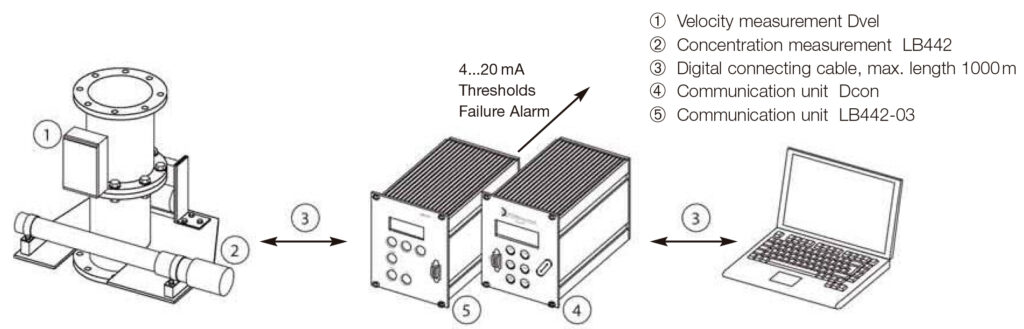
The Drad system combines the measured values of radiometric concentration measurement and transport speed (Dvel) to determine the mass throughput in pneumatic conveying systems and free-fall applications.
Drad has proven itself many times around the world, particularly for controlling fly ash humidification in power plants at up to 600 t/h.
Because the measuring technology is contact-free, there are no maintenance costs.
Function
How the radiometric measurement works
The radiometric density measurement is based on the principle of gamma transmission. Gamma radiation is weakened as it passes through the pipeline, and a detector records this attenuation. The attenuation is proportional to the density of the measured material. The measurement is not influenced by temperature, pressure, viscosity, color or chemical product properties.
- Contact-free
- No wear
- Maintenance-free
- Precise
- Independent of temperature, pressure, dust, color, conductivity and chemical product properties
- Ideal for extreme measuring conditions
More information on the speed measurement is available on the Dvel page.
The flow rate is the product of density, velocity and pipe cross-section.
Mounting and installation
Installation
The diagram shows how the Drad system is installed in the line.
Technical data
Drad specifications
Transcribed from the product brochure, with converted units added. Confirm critical values against the brochure PDF.
| Measurement methods | Velocity: non-contact electrostatic / capacitiveConcentration: non-contact radiometric |
|---|---|
| Size | DN 100 to DN 400 (4 to 16 in); DIN flange, ANSI flange |
| Measuring range | Velocity: 2 to 30 m/s (6.6 to 98 ft/s)Concentration: 50 to 1000 kg/m³ (3.1 to 62.4 lb/ft³)Flow rate: up to 500 t/h |
| Accuracy | Typically 1% of the end value |
| Measuring material | Bulk materials of any kind |
| Type of conveying | Pneumatic conveying, free fall |
| Installation position | Any |
| Materials | Housing: steel, galvanized and coated, or stainless steelSensor pipe for velocity measurement: glass fibre reinforced epoxy (standard) |
| Temperature | Environment: −20 to 70 °C (−4 to 158 °F)Process: −20 to 120 °C (−4 to 248 °F)Storage: −20 to 80 °C (−4 to 176 °F) |
| Pressure | Up to 64 bar (928 psi) |
| Protection class | IP 67 |
| Housing | 19 in slide-in module, closed |
|---|---|
| Dimensions | 107 × 128 × 173 mm (4.2 × 5.0 × 6.8 in) |
| Weight | 1.4 kg (3.1 lb) |
| Protection class | IP 20 |
| Supply voltage | 2 versions: 230 V AC or 24 V DC |
| Temperature | Environment: 0 to 50 °C (32 to 122 °F)Storage: −10 to 50 °C (14 to 122 °F) |
| Display | LCD, 4 × 20 digits, illuminated |
| Interface | CAN bus, Ethernet |
| Input | Current input 4–20 mA |
| Output | 2 × current output 4–20 mA2 × threshold relays, 1 × alarm relay |
| Connection cable | Digital, max. length 1000 m (3,280 ft) |

Application examples
Drad in real processes


Common questions
Drad FAQ
How does the Drad measure mass flow?
It combines radiometric concentration measurement with transport speed measurement (Dvel). The flow rate is the product of density, velocity and pipe cross-section.
What is the radiometric measurement based on?
Gamma transmission. Gamma radiation is weakened as it passes through the pipeline, a detector records the attenuation, and the attenuation is proportional to the density of the material.
What is the Drad typically used for?
High flow rates in pneumatic conveying and free-fall applications. It has proven itself for controlling fly ash humidification in power plants at up to 600 t/h.
Is the Drad affected by product properties?
No. The measurement is not influenced by temperature, pressure, viscosity, color or chemical product properties, and it is unaffected by changing bulk density or moisture.
What pressure can the Drad handle?
It is pressure resistant up to 64 bar (928 psi).
Does the Drad need maintenance?
The measuring technology is contact-free, with no wear, so there are no maintenance costs.
Talk with GTS
Is Drad right for your material?
Tell us what you're conveying, the pipe size and how it moves. We'll confirm whether Drad fits or recommend a better measurement principle.