
Dust emission monitoring
DUSTguard Broken-Bag Detector
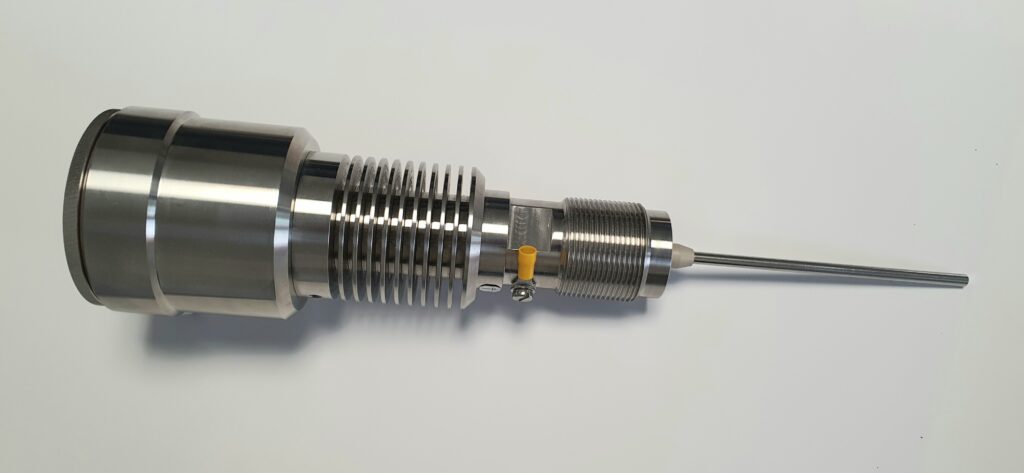
A low-cost broken-bag detector that catches filter leaks and trends high-level emissions on the clean-gas side of a filter. It detects all dust types down to 0.1 mg/m³ and has no moving parts.
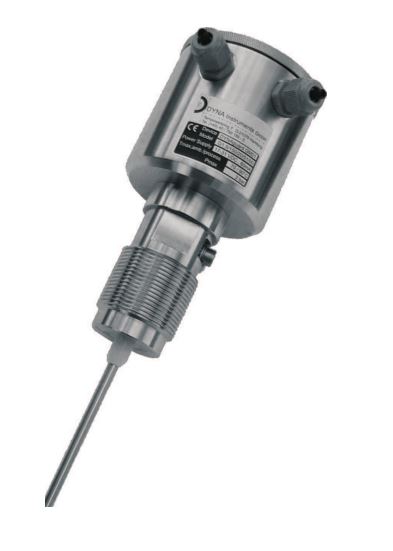
- Low-cost broken-bag detector for filter leaks
- Contact measurement, passive, with no moving parts
- Detects moving material only, with no influence from deposits
- Detects all dust types, with a sensitivity of 0.1 mg/m³
- Output signal: 4–20 mA or relay
- Compact design in a stainless steel housing
- Simple commissioning (plug and play)
- Reliable, long-term stable and maintenance-free
- High-temperature version up to 290 °C (554 °F)
Use
Where DUSTguard fits
DUSTguard detects or trends high-level emissions and filter malfunctions such as broken bags in a baghouse. It is mounted on the clean-gas side, downstream of the filter, on a metal duct.
Three electronics versions are available: analog (GM20), relay (GM01) and transistor (GM02). Under normal conditions the device is adapted to the process with switches and a potentiometer. On the GM01 and GM02, the alarm level can be set above the background level. Signal damping is adjustable.
Commissioning needs no tools or special equipment.
Function
How the electrostatic measurement works
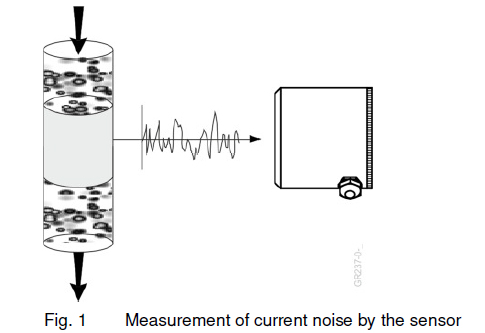
DUSTguard works on a modified triboelectric principle. Particles charged by friction or fracture induce a signal against the grounded duct as they pass the sensing rod or interact with it.
Statistical fluctuations in the particle flow create current noise, which rises with particle concentration and transport velocity. The electronics relate this noise to mass throughput or concentration. Adjustment to the process is manual, through internal controls.
Deposits on the rod are not detected. Only moving particles produce a signal.
DUSTguard is not suitable for products that form an electrically conductive layer on the sensor through abrasion or caking.
Mounting and installation
Installation requirements
Weld a thread bush to the duct, bore through the duct wall and screw in the sensor. The sensor rod should be one third to two thirds of the duct diameter, up to 800 mm (31.5 in).
- Keep at least three duct diameters of straight run upstream and downstream, with no valves or dampers.
- Any orientation is allowed. Vertical downward flow gives the steadiest readings.
- Calming sections: an inlet of 10 × inner diameter for pneumatic conveying or 2 × for a falling process, and an outlet of 5 × for pneumatic conveying or 2 × for a falling process.
- Above 80 °C (176 °F) process temperature, isolate the electronics thermally. High-temperature versions are available.
- Do not mount the head above hot pipes, and do not insulate around the head housing.
- Heat the head housing below −20 °C (−4 °F), and use a weather hood in direct sunlight.
- Avoid vibration at the installation point.
- Ground the device, and open the housing only when it is voltage-free.
Technical data
DUSTguard specifications
Transcribed from the product brochure, with converted units added. Confirm critical values against the brochure PDF.
| Supply voltage | GM01/GM02: 17 to 31 V DC, max. 60 mAGM20: 17 to 31 V DC, max. 90 mA |
|---|---|
| Relay output (GM01) | Max. 48 V AC/DC, 1 A; high / low switchable |
| Transistor output (GM02) | Galvanically isolated, max. 31 V DC, 15 mA; high / low switchable |
| Analog output (GM20) | 4–20 mA, galvanically isolated, load < 500 Ω; zero set 4 mA |
| Damping | GM01/GM02: 0 to 10 sGM20: 0 to 180 s |
| Switch point (GM01/GM02) | 1 to 10 |
| Sensitivity adjustment | 1 to 180,000 |
| Process sensitivity | 0.1 mg/m³ |
|---|---|
| Process temperature | Max. 90 °C (194 °F), standardOptions: 130 °C (266 °F) and 200 °C (392 °F) high-temperature versions |
| Ambient temperature | −20 to +70 °C (−4 to +158 °F) |
| Pressure | Max. 6 bar (87 psi) |
| Degree of protection | IP 67 (EN 60529) |
| EMC | EN 61326-1 |
| Ex2 option | ATEX Zone 2 and 22: II 3G EEx nA II T4; II 3D IP67 T100°C |
| Sensor rod | Stainless steel 1.4571 (AISI 316Ti), 40 to 800 mm long (1.6 to 31.5 in) |
|---|---|
| Sensor insulation | PA, 2 mm (standard); PTFE or PEEK optional |
| Seals | NBR (standard); FPM or silicone optional |
| Thread bush | 1.4301 (AISI 304) or 1.4571 (AISI 316Ti) |
| Process connection | G ½ in or G 1½ in thread; Tri-Clover clamp optional |
| Housing diameter | Ø 89 mm (3.5 in) |
| Cable gland | M16 × 1.5 |
Application examples
DUSTguard in real processes
Common questions
DUSTguard FAQ
What is DUSTguard used for?
Detecting or trending high-level emissions and filter malfunctions such as broken bags, on the clean-gas side downstream of a filter.
How sensitive is DUSTguard?
It detects all dust types with a sensitivity of 0.1 mg/m³.
What outputs does DUSTguard have?
Three electronics versions: analog 4–20 mA (GM20), relay (GM01) and transistor (GM02).
How long should the DUSTguard sensor rod be?
One third to two thirds of the duct diameter, up to a maximum of 800 mm (31.5 in).
Do deposits on the rod affect DUSTguard?
No. Deposits are not detected. Only moving particles produce a signal.
When is DUSTguard not suitable?
With products that form an electrically conductive layer on the sensor through abrasion or caking.
Talk with GTS
Is DUSTguard right for your material?
Tell us what dust you're filtering, the duct size and the gas temperature. We'll confirm which DUSTguard version fits.