
Flow / no flow detection
FLOWguard V Solids Flow Monitor for Pipelines
An electrostatic flow monitor for solids in pipelines, built as an electronics module that pairs with a range of process couplings. It handles throughputs from a few g/h to many t/h and trends even extremely slow flow.

- Electrostatic / triboelectric
- Non-contact and passive
- Electronics module without process coupling
- Numerous process coupling options available
- Monitors solids flow in free fall, sliding or pneumatic conveyors
- Detects moving material only, with no influence from deposits
- Flow trend for extremely slow velocity, such as plastic pellet extrusion
- Flow indication on an LED bar (relay version)
- Relay or analog output (4–20 mA)
- Reliable, long-term stable and maintenance-free
Use
Where FLOWguard V fits
FLOWguard V monitors solids flow in pipelines such as pneumatic conveying systems or drop sections, with throughputs from a few g/h to many t/h.
Faults or plugs in powders, granules, pellets and other bulk materials are detected early, which prevents clogged pipes, material loss, idling and other serious problems.
The V-series sensor electronics are used with ESR-series sensor mechanics.


Function
How the electrostatic measurement works
Particles in the flow carry electrical charges produced by friction, for example with the pipe wall. FLOWguard V detects these moving charges. Stationary solids, lining and build-up are not detected.
A range of sensor mechanics allows process coupling and cost-effective solutions, including in existing systems. The modular design also helps with replacement, retrofitting and upgrading.
FLOWguard V cannot be used for products that form an electrically conductive layer on the sensor or the inner wall, through friction, abrasion, deposition or caking.

Mounting and installation
Process coupling options
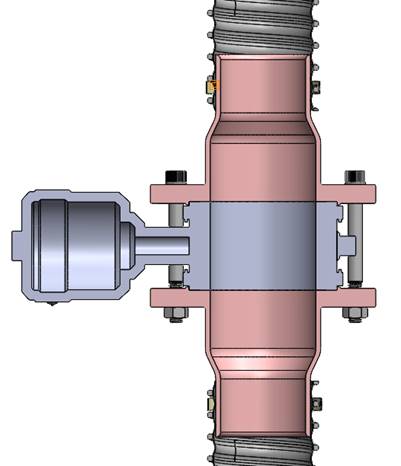
The electronics module mounts on ESR-series sensor mechanics, which are sold separately. Eight mounting versions are available:
- ESR_BR: flanged edge
- ESR_CL: clamp connection
- ESR_F: DIN / ANSI flange
- ESR_ZF: intermediate flange
- ESR_SV: plastic pipe
- ESR_RS: pipe connection
- ESR_RE: rectangle
- ESR_TR: funnel
An Ex2 version is available for ATEX Zone 2 and/or 22.


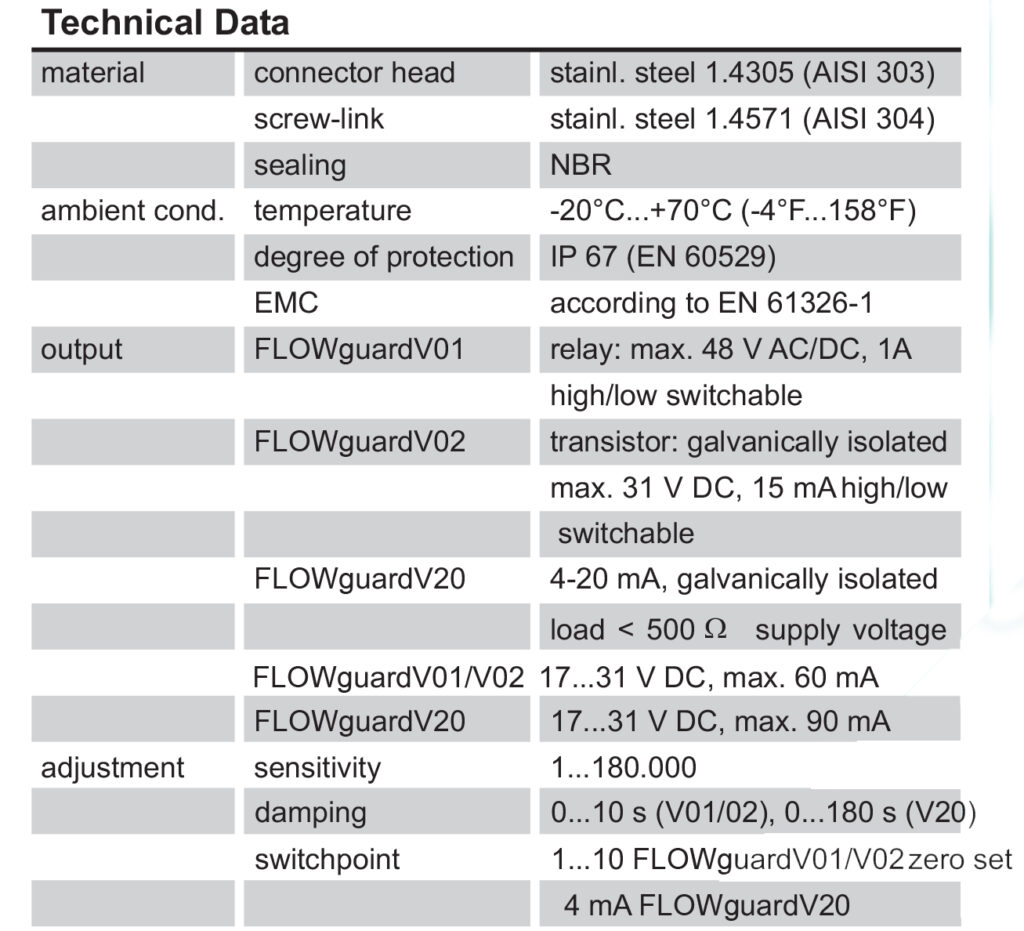
Technical data
FLOWguard V specifications
Transcribed from the product brochure, with converted units added. Confirm critical values against the brochure PDF.
| Supply voltage | V01/V02: 17 to 31 V DC, max. 60 mAV20: 17 to 31 V DC, max. 90 mA |
|---|---|
| Relay output (V01) | Max. 48 V AC/DC, 1 A; high / low switchable |
| Transistor output (V02) | Galvanically isolated, max. 31 V DC, 15 mA; high / low switchable |
| Analog output (V20) | 4–20 mA, galvanically isolated, load < 500 Ω |
| Damping | V01/V02: 0 to 10 sV20: 0 to 180 s |
| Switch point | 1 to 10 |
| Zero set (V20) | 4 mA |
| Sensitivity adjustment | 1 to 180,000 |
| Mass flow range | g/h to t/h |
|---|---|
| Ambient temperature | −20 to +70 °C (−4 to +158 °F) |
| Degree of protection | IP 67 (EN 60529) |
| EMC | EN 61326-1 |
| Ex2 version | ATEX Zone 2 and/or 22 |
| Housing | Stainless steel |
|---|---|
| Connector head | Stainless steel 1.4305 (AISI 303) |
| Screw link | Stainless steel 1.4571 |
| Sealing | NBR |
| Housing diameter | Ø 89 mm (3.5 in) |
| Thread | M16 × 1.5 |
| Process couplings | Sold separately (ESR series) |
Application examples
FLOWguard V in real processes
Common questions
FLOWguard V FAQ
What does FLOWguard V monitor?
Solids flow in pipelines such as pneumatic conveying systems or drop sections, at throughputs from a few g/h to many t/h.
How does FLOWguard V work?
It detects the moving electrical charges that particles pick up through friction, for example with the pipe wall. Stationary solids, lining and build-up are not detected.
How is FLOWguard V mounted?
The electronics module pairs with ESR-series sensor mechanics. Eight versions are available: flanged edge, clamp connection, DIN / ANSI flange, intermediate flange, plastic pipe, pipe connection, rectangle and funnel.
Can FLOWguard V trend very slow flow?
Yes. It gives a flow trend for extremely slow velocity, such as plastic pellet extrusion.
What outputs does FLOWguard V have?
A relay output with LED bar flow indication (V01), a transistor output (V02), or a 4–20 mA analog output (V20).
When can FLOWguard V not be used?
With products that form an electrically conductive layer on the sensor or the inner wall.
Talk with GTS
Is FLOWguard V right for your material?
Tell us what material is moving, the line size and how you'd like to mount the sensor. We'll confirm which FLOWguard V coupling fits.